examples of 3d faces drawings
- Domicile
- Portrait Drawing
- Drawing Faces
Drawing Faces:
Shading a Realistic Portrait
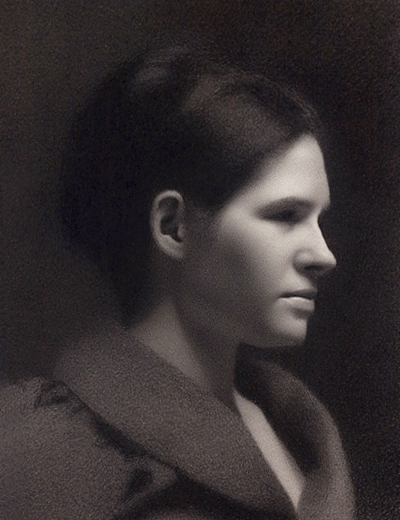
Shading, or rendering, is one of my favorite stages of drawing faces. It is so rewarding to see your portrait slowly go three-dimensional, and come to life. That is exactly what I'll work on in this second half of the portrait drawing tutorial!
Return to Portrait Drawing Tutorial Office 1: Blocking in a Portrait here.
Earlier you brainstorm adding value to your drawing, recollect that your block-in is of the utmost importance. Take as much time equally you need to make sure that it is accurate. You shouldn't have to make whatsoever drastic changes to the proportions, shadow shapes or structure of the moving-picture show during the value stage!
Rendering your portrait will progress smoothly if ...
- the head and features are well placed and constructed (learn how to draw eyes, lips and ears hither)
- you accept closely observed and fatigued in the shadow shapes, and
- you accept a good understanding of value
Let'southward option upwardly where I left off in the kickoff half of this portrait drawing tutorial.
As I start cartoon in the values, my initial goal is to cover the white of the paper as quickly as possible. Why? Considering we can only judge the accuracy of a value by comparing information technology to its surrounding values!
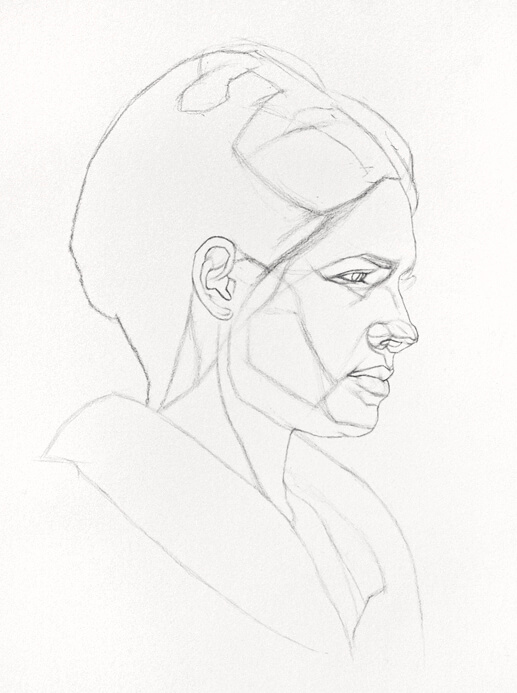
Values are relational, meaning that what surrounds a value greatly affects how we perceive it. A value surrounded past white tin can await much darker than a value surrounded by darker values.
In order to accurately guess the value relationships in our drawing, we must first institute some full general value relationships throughout our image, and embrace up the white of the newspaper where it's non needed.
Then, after the block-in, the side by side pace in drawing faces is to mass in the values.
Drawing Faces: Adding Tone to your Drawing
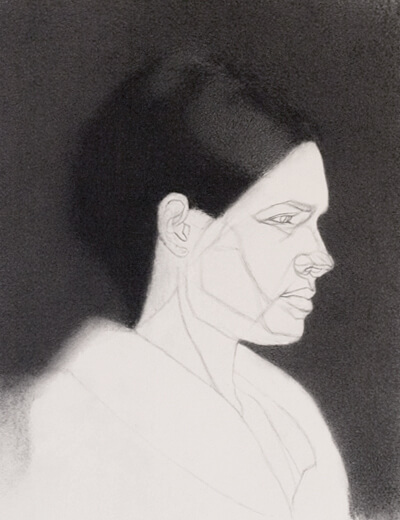
Although I covered a lot of expanse in this step, information technology was actually very simple.
All I did was mass in 3 values: a value for the background, a value for the dark shape of the pilus, and a value for the light shape in the pilus.
It is already beginning to await three-dimensional because of the very soft border that merges the pilus shape with the groundwork: soft edges recede, and sharp edges come up forward.
Larn all virtually edges in Lesson 6 of my free Mini-Class.
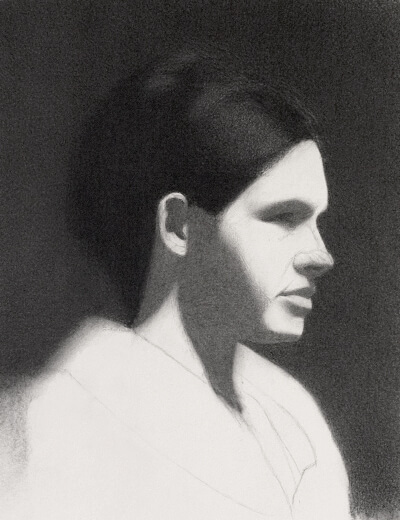
I mass in the shadow shapes on the face with i or two values at most, and I darken the eye and nostril just then I don't completely lose the shapes.
In this beginning phase of drawing in tone, I make the values even plenty to compare them, only am not concerned with rendering any gradations or specifics yet. My values are but 'blocked in', not rendered, meaning that they are not very evenly drawn even so.
This is because as I continue the drawing and discover what changes have to be fabricated, I will have to modify the values, and so it doesn't brand sense to spend time beautifully rendering them at this bespeak.
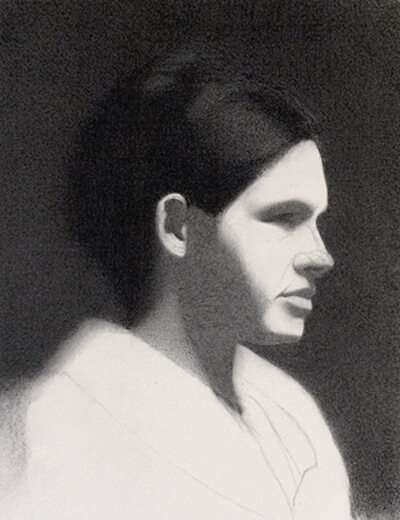
I keep drawing in the general value masses.
Hither I accept laid in an approximate value for the light shape on the neck.
I accept too worked on the shadow portion below the ear, softening the border where the hairline meets the neck.
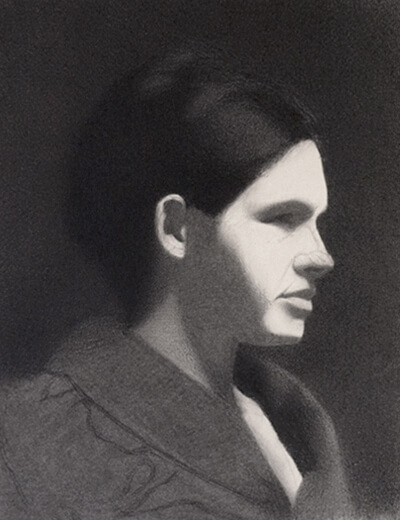
Although this tutorial is about drawing faces, addressing the background and clothing can "complete the illusion".
Treat the clothing as you would any other surface area of your drawing: by first massing in the full general values.
In one case I have washed this, I have reached an of import phase in the drawing: the just area where I tin can still see the white of the paper is the lite area on the face, and the breast and collarbone area.
I can at present focus on comparing and modifying my values.
Drawing Faces: Analyzing the Values of the Face
In that location are so many interesting tonal differences happening within the shadows on the face up!
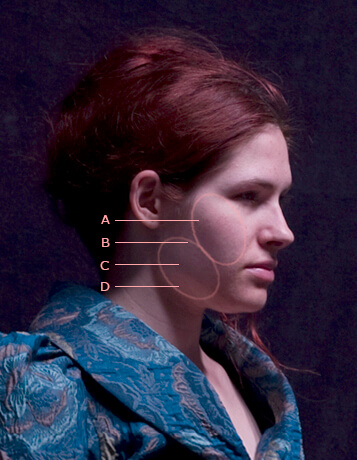
There are 2 core shadows : at points A and C.
This is happening because there are two forms on the side plane of the confront: the cheekbone area, and the jaw area, both of which tin exist idea of every bit egg-shaped forms (as I take indicated).
The low-cal is perpendicular to the class where yous see the highlight on the cheek. It and then becomes darker until it can no longer accomplish the form (this is the elevation core shadow, or Point A). The form of the jaw then begins at point B. It catches a sliver of light from the light source before turning away at point C, which is the second cadre shadow.
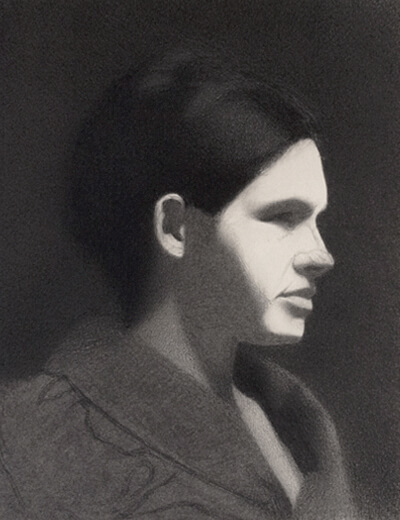
Point D is much lighter than the rest of the shadow due to reflected light. Light is reflected off of the model'southward chest, and bounces support into the shadow under the chin. Earlier you brainstorm developing the tonal differences in the shadow on the cheek and jaw, observe how much information is lost when y'all squint at this area. In order to create the illusion of three-dimensionality, yous must preserve the contrast between the light and night value groups in your picture.
To create enough difference between the light and the nighttime value groups, depict just what yous run across when you squint! Notice how dark I made the reflected light in my cartoon, fifty-fifty though it appeared to be quite light on the model.

Next, I find and draw the 'darkest nighttime values', or darkest accents, within the shadows on the face. In this case the 'darkest darks' on the face up are: the center, the nostril, and simply where the upper lip turns away and meets the lower lip.
I take besides started rendering the forms of the ear. Notice how much more than of a sense of depth information technology has gained since the last pace! All from indicating the helix and anti-helix of the ear. Learn nigh the structure of the ear in my ear drawing tutorial.
Don't miss these tutorials on drawing the features of the face:
- How to Draw Realistic Eyes Step by Stride
- How to Draw Realistic Lips Footstep by Footstep
- How to Describe an Ear on Toned Paper
Drawing Faces: Rendering
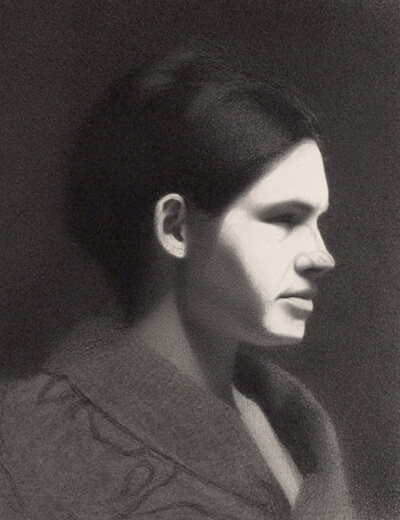
Begin rendering the one-half-tone values of the face with a value or edge that seems piece of cake and obvious to you lot.
For instance, I began shading past softening the edge of the hairline against the face.
I and then started drawing the gradation on the temple, from the eyebrow to the hairline.
(Cheque out this tutorial on how to depict eyebrows here!)
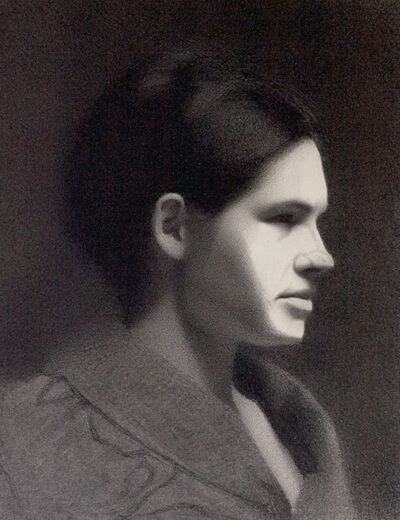
I go along 'turning the form', or softening the edges from the shadows into the one-half-tones of the face.
More than specifically, I'one thousand working on rendering the edge from the shadow on the cheek towards the middle, creating a rounded form that flattens out at the temple.
Sentry Lesson 6 of my free mini-course to view four shading techniques for softening edges!
Since the last pace I accept also toned downwardly the low-cal area of the ear, as it is far from the lightest value in this portrait, and I don't want it to draw attention away from the face.
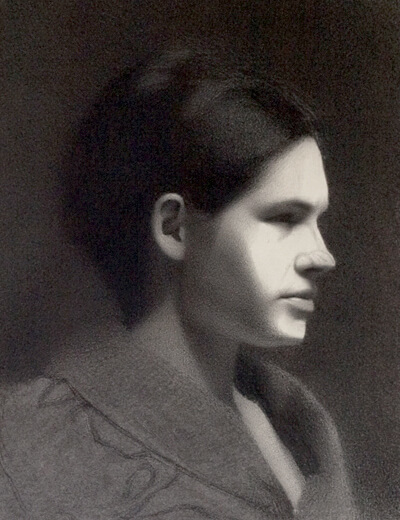
Some schools teach that you should begin rendering on one side of the face and shade until y'all attain the other side. While this is a perfectly valid method, I personally adopt to render unlike areas effectually the face up. I work from dark to calorie-free, or I draw the values that are most clear to me and work towards the more subtle ones.
For case, you can ask yourself: what is the darkest value on the low-cal shape of the face? (What is the 'darkest light'?)
Perhaps that bottom lip. Furthermore, that value may be fairly easy to draw accurately because I can compare it to the value of the shadow just below information technology, and to the upper lip.
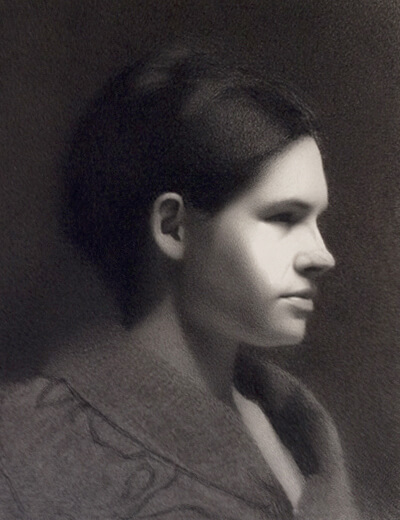
Once I found the value of the lesser lip, it becomes some other variable that I tin can compare the residuum of the values to.
(View a step by pace lip drawing tutorial here!)
From the lip, I motion on to rendering the chin.
I also begin cartoon the different edge qualities of the eyebrow, and from in that location, begin rendering the forehead.
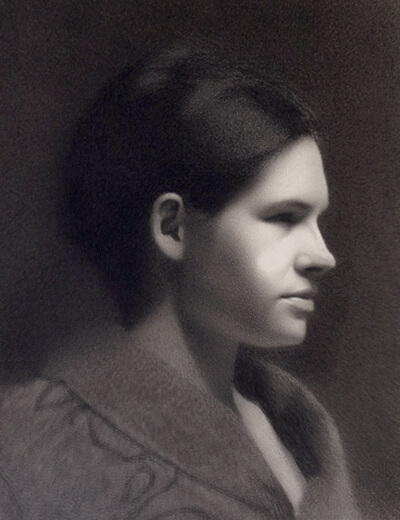
I continue rendering the face.
Constantly refer to the model as you render, asking yourself questions such as:
- What is the lightest area on the face?
- Are there highlights on the face, and if yes, where are they?
- Where is the sharpest edge on the face up?
- Where is the softest edge on the confront?
- Is my center drawn to my intended focal point when I expect at my drawing?
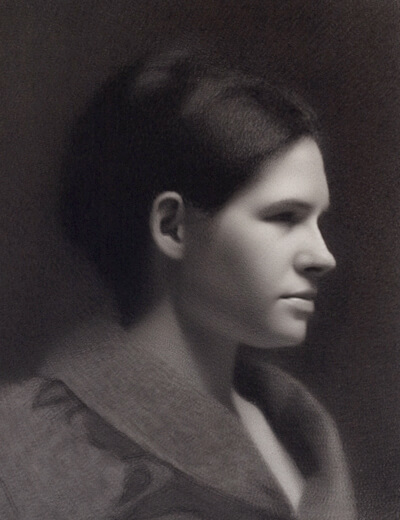
Retrieve to pace dorsum from your picture regularly when cartoon faces. Looking at it from afar volition help yous to notice what is working and what is non.
I want the focal betoken of the picture to be the face, just when I await at my drawing, I notice that the face isn't attracting and belongings enough of my attention.
Instead, I notice that my eye apace drops to the calorie-free shape on the chest. Referring back to the model, I realize that I take slightly overmodelled the face. Overmodelling occurs when in that location is non enough contrast between the light and dark value families. (A synonym for overmodelling could be "over-shading".)
Essentially the calorie-free values in the face are not lite enough. The highlights in particular could be considerably brighter.
This weakens the value structure, and causes the drawing to look less believable. This is a common drawing problem to lookout out for, especially when cartoon faces.
Hither I have brightened the calorie-free areas on the face, and put in the finishing touches: the highlights on the nose and the lip.
The wearable is drawn simply, so as not to detract from the focal point of the image: the face.
And here is my finished portrait drawing!
I promise y'all enjoyed this tutorial on shading a portrait drawing! Missed the get-go page on blocking in the portrait? Return to Folio 1 of the Portrait Cartoon Tutorial here.
What adjacent?
Why non larn how to draw the features of the face up, such every bit the eyes, lips and ears?
Before you get, don't miss the downloadable Infographic of this tutorial beneath.
Happy Drawing!
F R Eastward E D O West N L O A D
Get a free Infographic on Shading the Portrait
(plus, become a weekly newsletter and access to the Members-Only Drawing Resource Library)!

Enjoyed this folio? Delight share it!
Share buttons and pinnable image beneath:

If yous enjoyed this page on drawing faces, you might also be interested in:
Related Pages
How to Draw Realistic Optics
8 Most Common Eye Cartoon Mistakes (and how to avoid them!)
How to Draw Realistic Lips
How to Draw an Ear on Toned Paper
Render to Portrait Drawing from Cartoon Faces
Return to Drawing Tutorials from Drawing Faces
Return to the Domicile Page from Drawing Faces
pattonintentookey.blogspot.com
Source: https://www.thedrawingsource.com/drawing-faces.html
0 Response to "examples of 3d faces drawings"
Post a Comment